
The great Indian epics have never belonged to a single book, language, artistic tradition or historical period. Their remarkable longevity rests, in large measure, on their capacity to be retold, reinterpreted and rediscovered by successive generations. The Ramayana and the Mahabharata have travelled through Sanskrit manuscripts, regional literary traditions, oral narratives, folk performances, temple architecture, classical dance, puppetry, paintings and, more recently, television and cinema. They have accommodated different languages, geographical imaginations, religious interpretations and cultural sensibilities without surrendering their fundamental place in the Indian civilisational imagination. Their survival is, therefore, not merely a consequence of preservation but also of continuous reinvention. This reinvention allows every aspect, various perspectives, and multiple points of view without any bias or hindrance – a true testament to the great Indian “shashtrath” tradition. Cinema is not an intruder into this tradition. It is its latest and perhaps most influential medium of transmission. However, the enormous possibilities of the screen come with an equally significant responsibility: to preserve the intellectual, philosophical and ethical depth of narratives that have never been intended as mere spectacles. The challenge before contemporary filmmakers is not simply to make these stories look magnificent but to understand what makes them meaningful.
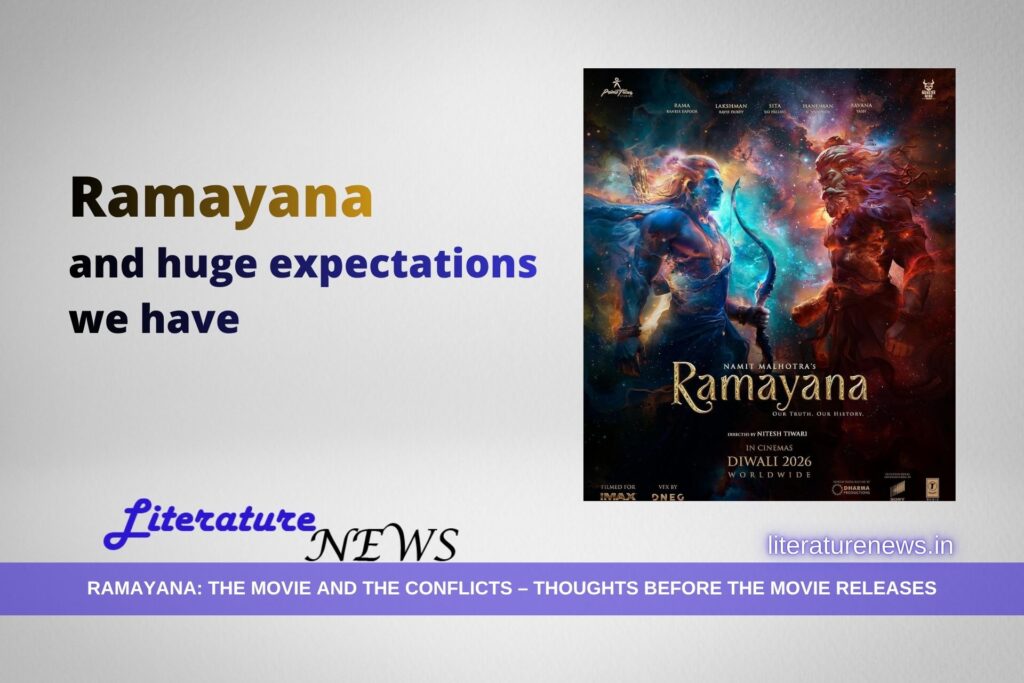
The immediate occasion for revisiting this question is Nitesh Tiwari’s Ramayana: Part One, scheduled for worldwide theatrical release on 5 November 2026. Featuring Ranbir Kapoor as Rama, Sai Pallavi as Sita, Yash as Ravana, Sunny Deol as Hanuman and Ravie Dubey as Lakshmana, the film represents an ambitious attempt to bring one of India’s most influential epics to an international cinematic audience. Produced by Namit Malhotra’s Prime Focus Studios in association with DNEG and Yash’s Monster Mind Creations, the two-part project brings together substantial filmmaking and visual-effects resources. Its technical ambitions are further reflected in its association with IMAX, the international distribution arrangement with Sony Pictures and a musical collaboration between A. R. Rahman and Hans Zimmer. The second instalment was originally announced for Diwali 2027. The scale of this undertaking is noteworthy, but its cultural significance cannot be measured through production expenditure, star power, technological innovation or international distribution alone. An adaptation of the Ramayana carries a responsibility that extends well beyond the expectations of the entertainment industry. It must engage with a narrative that has shaped the moral vocabulary, artistic expressions and collective memories of generations of Indians. The more ambitious the production, the greater the expectation that it will demonstrate an equally ambitious understanding of its source.
There is a compelling reason why the Indian epics lend themselves so naturally to cinematic interpretation. Both possess the essential ingredients of powerful drama, but their appeal extends far beyond the conventional conflict between good and evil. The Ramayana presents a complex narrative of exile, loyalty, sacrifice, love, power, duty and the consequences of moral decisions. The Mahabharata, meanwhile, is an extraordinary exploration of human ambition, political rivalry, familial obligations, injustice and the devastating consequences of an inability to distinguish between personal interests and collective welfare. Its central conflict is not simply a war between two branches of a royal family. It is a civilisational crisis in which almost every principal character must confront the consequences of a choice. Consider Draupadi’s humiliation in the royal assembly, Bhishma’s silence in the face of injustice, Karna’s loyalty to Duryodhana despite knowing the moral implications of his association, or Arjuna’s hesitation on the battlefield. These episodes possess a dramatic intensity that requires no artificial embellishment. Their significance lies in the ethical questions they raise. Similarly, the Ramayana offers moments of extraordinary emotional and dramatic power, from Rama’s departure for the forest to Sita’s abduction, Hanuman’s journey to Lanka and the eventual confrontation between Rama and Ravana. Cinema can give these moments a visual and emotional immediacy that reaches audiences who may never have encountered the original literary works. Yet it must remember that the spectacle is only the outward expression of a much deeper narrative.
India has already witnessed the extraordinary influence of televised adaptations of its epics. Ramanand Sagar’s Ramayan, broadcast on Doordarshan from 1987 to 1988, and B. R. Chopra’s Mahabharat, broadcast from 1988 to 1990, demonstrated that these narratives could transcend geographical and linguistic boundaries through the medium of television. Their success was not merely a matter of entertainment. They created a shared cultural experience in which families and communities gathered to watch familiar stories unfold on their television screens. Their visual conventions may appear dated to contemporary viewers, but their historical significance remains considerable. They introduced generations of audiences to characters, episodes and moral questions that had previously reached them through family traditions, religious performances, regional literature and oral storytelling. The present generation of filmmakers has inherited a cultural foundation established partly by these productions. However, the technological and artistic possibilities available today are substantially different. Computer-generated imagery, advanced sound design, motion capture, international production collaborations and large-format cinematography have transformed the possibilities of visual storytelling. Tiwari’s Ramayana seeks to operate within this new cinematic environment. It is designed not merely as another television-style retelling but as a large-scale theatrical experience intended to reach audiences across linguistic and national boundaries. Such an ambition deserves recognition, but it also invites a more demanding standard of evaluation.
One of the strongest arguments in favour of adapting the epics for contemporary cinema is accessibility. The literary traditions associated with the Ramayana and the Mahabharata are vast, multilingual and intellectually demanding. Valmiki’s Sanskrit Ramayana, Tulsidas’s Ramcharitmanas, Kamban’s Tamil Ramavataram and the numerous regional and folk retellings offer different approaches to the same broad narrative tradition. Similarly, the Mahabharata exists not simply as a monumental Sanskrit text but as a living narrative that has been adapted into regional languages, theatrical forms and modern literary interpretations. Engaging with these works requires time, linguistic familiarity and, often, an understanding of the historical and philosophical contexts in which they developed. Cinema can introduce their principal characters and conflicts to audiences who might otherwise remain unfamiliar with their literary richness. A young viewer may first encounter Rama, Sita, Ravana or Hanuman through a film and subsequently develop an interest in reading the original texts. Such an outcome would be a meaningful contribution to literary and cultural education. However, accessibility should never be confused with intellectual simplification. A film that makes an epic accessible by removing its difficult questions may succeed as entertainment while failing as an interpretation of its source. The objective should be to encourage curiosity, not replace the necessity of reading, reflection and independent understanding.
The visual possibilities are equally significant. The descriptions of ancient kingdoms, vast forests, celestial weapons, elaborate palaces, extraordinary journeys and monumental battles offer filmmakers an opportunity to create cinematic environments of considerable imaginative richness. Modern visual effects can translate elements that once depended on the audience’s imagination or the conventions of theatrical representation into compelling visual experiences. Nevertheless, the greatest opportunity presented by technological advancement is not the ability to create larger battles or more impressive supernatural imagery. It is the opportunity to make the emotional and psychological dimensions of the narratives equally visible. The forest is not merely a picturesque location in the Ramayana; it is a space of exile, transformation, uncertainty and self-discovery. Lanka is not simply a magnificent fortress; it is the kingdom of a powerful ruler whose intellectual accomplishments cannot redeem his moral transgressions. Kurukshetra is not merely a battlefield; it is the setting of a profound philosophical crisis concerning action, duty, attachment and the nature of righteousness. If filmmakers understand these dimensions, technological sophistication can deepen the audience’s engagement with the epics. Otherwise, the most expensive visual effects may become little more than elaborate decoration.
Another important responsibility of contemporary adaptations is to recognise that the epics are not exclusively narratives of their principal heroes. Their literary and philosophical richness also emerges through characters who occupy the margins of conventional storytelling. The Ramayana offers considerable scope for exploring Urmila’s largely overlooked sacrifice, Mandodari’s dignity, Shabari’s devotion and the difficult position of characters whose choices are constrained by circumstances beyond their control. The Mahabharata provides equally compelling possibilities through Kunti, Gandhari, Vidura, Ekalavya, Karna and Draupadi. These characters are not incidental additions to the central narrative. They reveal its moral complexity. Ekalavya’s story, for instance, raises difficult questions about access to knowledge, social hierarchy, privilege and the unequal distribution of opportunity. Draupadi’s interrogation of the assembly following the game of dice remains one of the most powerful challenges to institutionalised injustice in Indian literature. Gandhari’s grief and Kunti’s complicated relationship with her sons reveal the emotional consequences of decisions taken in the name of duty, political necessity and family honour. A thoughtful adaptation need not give every character equal screen time, but it should resist the temptation to reduce the epic to a straightforward contest between a celebrated hero and a formidable antagonist. The human drama of these narratives is distributed across their characters, and their significance often becomes clearer when the principal action is viewed from less familiar perspectives.
However, the transition from literature to cinema is not without serious limitations. Literature can accommodate ambiguity, silence, philosophical reflection and multiple interpretations in ways that commercial cinema often struggles to sustain. An epic can spend considerable narrative time examining a moral dilemma without necessarily resolving it. Cinema, particularly when conceived as a large-scale commercial production, frequently depends on dramatic momentum, clearly defined character motivations, identifiable antagonists and emotionally satisfying conclusions. These demands can create pressure to simplify precisely those aspects of the original narratives that deserve the greatest attention. Ravana may become little more than an embodiment of evil, despite his learning, devotion, political achievements and formidable intellectual abilities. Rama may be presented as an unquestionable ideal, leaving little room for examining the difficult ethical questions associated with his decisions. Sita may be celebrated for her purity and endurance while her agency, intelligence and suffering receive insufficient attention. Such representations may appear appropriate within a conventional heroic narrative, but they risk diminishing the philosophical depth of the source material. The greatness of the Ramayana does not depend on the absence of difficult questions. Indeed, many of its most enduring debates arise because its characters and their actions invite scrutiny. A responsible adaptation must have the courage to preserve that discomfort rather than resolve every contradiction in favour of an uncomplicated moral conclusion.
This responsibility becomes even more important when one considers the religious and cultural significance of the epics in contemporary India. The Ramayana is not simply an ancient literary composition preserved in libraries and academic institutions. It is part of a living religious and cultural tradition for millions of people. Its characters, episodes and teachings are encountered in prayer, festivals, family narratives, regional performances and everyday expressions of cultural identity. The same narrative also occupies an important place in literary scholarship, comparative mythology, folklore and the study of Indian civilisation. These overlapping identities make cinematic adaptation a particularly sensitive undertaking. A filmmaker must acknowledge the devotional relationship that audiences have with the story without assuming that devotion requires the elimination of critical inquiry. Equally, artistic freedom should not become an excuse for careless treatment of a culturally significant narrative. The challenge is to maintain a meaningful relationship between creative interpretation and cultural responsibility. Neither unquestioning reverence nor deliberate provocation is an adequate substitute for informed artistic judgement.
It is also essential to recognise that there is no single, universally exhaustive version of the Ramayana. The diversity of its retellings is one of the strongest indications of its continuing cultural vitality. Valmiki’s Sanskrit narrative, Tulsidas’s devotional interpretation, Kamban’s Tamil composition, Jain and Buddhist adaptations, Adivasi oral traditions and numerous Southeast Asian versions demonstrate how the epic has travelled across different communities and historical contexts. These narratives do not always agree in their treatment of characters, events and moral questions. Some foreground devotion, others emphasise philosophical reflection, regional identity or alternative perspectives on the central conflict. This diversity is not a weakness that needs to be corrected through a definitive cinematic version. It is a fundamental feature of the epic tradition. Consequently, no director, actor, production house or screenwriter can claim to offer the final interpretation of Rama, Sita or Ravana. Every adaptation is necessarily selective. It reflects the artistic imagination, cultural assumptions and historical circumstances of the people who produce it. The audience should therefore be encouraged to recognise a film as one interpretation among many, rather than as an authoritative replacement for the literary and cultural traditions from which it emerges.
Against this background, the expectations surrounding Nitesh Tiwari’s Ramayana must be assessed with considerable care. Its international production ambitions, prominent cast, advanced visual-effects infrastructure and collaboration between Indian and international creative professionals offer an opportunity to present an Indian epic through a technologically sophisticated cinematic language. The involvement of A. R. Rahman and Hans Zimmer is particularly interesting because music in an epic adaptation must do more than accompany dramatic action. It must help establish the emotional and cultural atmosphere of the narrative.
On this note of the supposedly great musical collaboration between Zimmer, whose legacy has already been cemented even more strongly with the performance in the F1 Movie, and Rahman, there are mixed reactions. Especially after the spread of a thought by Rahman that he does not care about the opinions and feedback of the audience. Many critics and music enthusiasts have claimed that a few songs feel like sufi songs or kawwalis, matching old productions by Rahman himself. Kumar Vishwas, the self-proclaimed “Yug-Vakta”, has also been criticised vehemently for his lyrics that create a mumble-jumble of words without any deeper sense or layered imagery one must expect from songs that will be filmed on legendary figures like Ram and Sita.
Similarly, the performances must be evaluated not simply on the physical resemblance of the actors to familiar representations of the characters but on their ability to communicate the inner conflicts and moral responsibilities associated with them. Ranbir Kapoor’s portrayal of Rama, Sai Pallavi’s interpretation of Sita and Yash’s performance as Ravana will inevitably attract considerable attention. Yet casting decisions should not become substitutes for critical evaluation. The central question is whether these performances will allow audiences to encounter recognisable human beings within larger-than-life circumstances. A convincing Rama must communicate responsibility as well as nobility. A compelling Sita must possess emotional and moral agency beyond the conventional expectations of idealised womanhood. An effective Ravana must be sufficiently complex to make his downfall meaningful. The artistic success of the film will depend on its ability to bring these dimensions together.
There is also a wider question concerning the international presentation of Indian cultural heritage. Indian cinema has long drawn upon mythology, history and religious traditions, but large-scale productions with international distribution ambitions offer a different opportunity. They can introduce audiences unfamiliar with Indian literary traditions to narratives that have influenced art, philosophy, performance and social imagination across South and Southeast Asia. However, presenting an Indian epic to the world should not mean reshaping it merely to accommodate international commercial expectations. Cultural accessibility does not require cultural dilution. The distinctive philosophical vocabulary of the Ramayana and the Mahabharata, particularly their engagement with dharma, karma, duty, attachment, renunciation and moral responsibility, should remain central to their interpretation. These ideas are not always easily translated into contemporary cinematic language, but that difficulty is precisely what makes the exercise worthwhile. International audiences do not need a simplified version of Indian civilisation. They need an intellectually engaging introduction to its literary and philosophical traditions. A film that trusts its audience to encounter unfamiliar ideas can achieve considerably more than one that reduces cultural difference to decorative costumes, elaborate rituals and spectacular battle sequences.
Ultimately, the success of a cinematic adaptation of India’s great epics must be measured by more than its opening-day collections, international screenings, technical achievements or popularity among fans. Commercial success is important for the sustainability of ambitious filmmaking, but it is not the ultimate measure of cultural achievement. A great adaptation should stimulate discussion, encourage reading, create opportunities for historical and philosophical inquiry and introduce neglected dimensions of familiar narratives. It should be capable of engaging a devoted audience without alienating the critical reader, and of attracting younger viewers without assuming that they have little patience for intellectual complexity. Most importantly, it should leave room for disagreement. The Ramayana and the Mahabharata have endured partly because generations have continued to discuss their characters, question their decisions and reinterpret their moral significance. Cinema should strengthen this tradition of engagement rather than bring it to a premature conclusion.
The question, therefore, is not whether India’s epics should be adapted for the screen. They have always been adapted, and their capacity for reinterpretation is one of the principal reasons for their extraordinary survival. The real question is whether contemporary filmmakers will approach them as valuable cultural properties to be commercially exploited or as living intellectual and artistic traditions deserving serious engagement. Nitesh Tiwari’s Ramayana arrives with considerable resources, international ambitions and expectations that extend far beyond the ordinary demands of a commercial film. It has the opportunity to become an important moment in the history of Indian cinematic storytelling. But that opportunity will be realised only if its artistic ambition matches its technological scale. The film should not merely make Lanka look magnificent, Ravana appear formidable, or Rama look heroic. It should help audiences understand why these characters have remained subjects of fascination, devotion, admiration and debate for centuries. Above all, it should remind viewers that the greatest achievement of an epic is not the spectacle of a battle won but the wisdom, questions and moral reflections that survive long after the battle has ended. If the new Ramayana succeeds in sending audiences back to Valmiki, Tulsidas, Kamban and the countless storytellers who have preserved this tradition, it will have accomplished something far more valuable than producing another cinematic blockbuster. It will have renewed an enduring conversation about duty, justice, compassion, power and the difficult responsibilities of being human.
Ashish for Literature News