
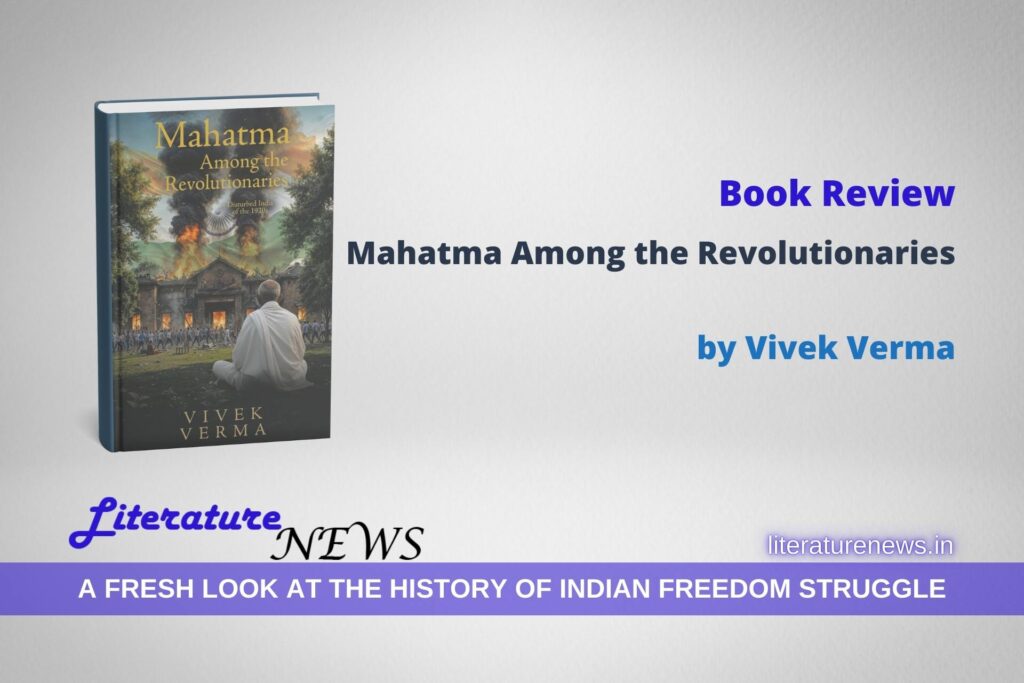
Mahatma Among the Revolutionaries is a book one should read not merely to revisit the Indian freedom struggle but to understand why it unfolded in the fractured, conflicted, and morally charged manner that it did. Author Vivek Verma does not offer comfort, nostalgia, or heroic reassurance. Instead, he invites the reader into a disturbed historical moment and asks them to stay there, to listen carefully to voices that disagreed sharply, and to accept that India’s independence was forged not through harmony but through sustained tension. This alone makes the book essential reading, particularly for those who believe they already “know” the story of the national movement.
What distinguishes this work from conventional histories is its insistence that the freedom struggle cannot be reduced to a single ethical path. Verma structures his narrative around coexistence rather than succession. Armed revolutionaries do not appear as a preliminary phase awaiting correction by Gandhian nonviolence, nor does Gandhi arrive as a moral antidote to revolutionary excess. Instead, both streams operate simultaneously, often uneasily, sometimes in open disagreement, yet constantly shaping the same political terrain. The book invites readers to abandon the habit of ranking methods and instead examine consequences, motivations, and historical constraints.
The early chapters ground the narrative in imperial realism rather than nationalist sentiment. When George Curzon is quoted as believing that British India was the “true fulcrum of Asian dominion,” and admitting that the loss of India would reduce Britain to “a third-rate power,” the reader immediately understands why independence was resisted so stubbornly. Verma uses this imperial candour to dismantle the myth of reluctant colonialism. India was not governed out of obligation or moral duty but because it was indispensable to British global power. This framing is crucial, for it explains why reform was always partial and why repression surfaced so readily when control seemed threatened.
Against this imperial backdrop, Verma places the emergence of revolutionary violence with analytical sobriety. The revolutionaries are not introduced as impulsive zealots but as political actors responding to systematic exclusion. Their belief that disorder could create a vacuum for new power is explained rather than caricatured. Verma is particularly careful in showing that many revolutionaries did not aspire to rule. Their aim was the destruction of illegitimate authority, not its inheritance. This perspective challenges the common assumption that violence was driven solely by impatience. It also helps readers understand why martyrdom carried such symbolic power among young Indians who saw no constitutional horizon.
There is another detail that one must not forget while reading or reviewing the book. It is contrary to what many other authors have attempted – bestowing sainthood on certain political leaders of the Indian freedom struggle. Surprisingly, there are many names that one would expect history writers and narrative weavers to put amongst the pedestals way beyond the reach of ordinary political figures, even the towering ones, for that matter. However, Vivek Verma denies that urge and resist against the trope. For instance, the book then introduces Gandhi not as a saint descending upon chaos, but as a political thinker shaped by his own evolution. Gandhi’s insistence that “there is no salvation for India unless you strip yourselves of this jewellery and hold it in trust for your countrymen” is read as an economic and ethical challenge to Indian elites as much as a critique of colonial exploitation. The author shows that Gandhi’s nationalism was inseparable from social transformation. His focus on the farmer and his distrust of lawyers, landlords, and professional classes reveal a radical reordering of political legitimacy. This makes Gandhi’s appeal to the masses intelligible rather than mystical. However, even in doing so, the author does not strip Gandhi of his political persuasion, charisma and intellect. He just puts him away from the hierarchy that defies others in ascribing Godly qualities to Gandhi!
At the same time, the book does not allow Gandhi to monopolise moral authority. The writer gives careful attention to Gandhi’s own acknowledgement of revolutionary anger. When Gandhi declares that he would not hesitate to say the English “would have to go” if India’s salvation demanded it, he demonstrates a moral firmness that is often overlooked. Yet Gandhi’s critique of the bomb thrower as one who works in secrecy and pays the price of “misdirected zeal” exposes a philosophical divide rather than moral contempt. Verma treats this divide as genuine and irreconcilable, not as a misunderstanding to be resolved retrospectively.
The turning point of the narrative is the colonial state’s abandonment of restraint. General Dyer’s admission that he wanted to make “a wide impression” and reduce morale throughout Punjab is presented without rhetorical embellishment. Verma allows the statement to stand as evidence of a governing philosophy rooted in fear. The Jallianwala Bagh massacre thus becomes not an exception but a revelation. Even Churchill’s condemnation that “frightfulness is not a remedy known to the British pharmacopoeia” is shown to be limited in its effect. Moral outrage did not translate into structural change. This failure deepened Indian distrust and legitimised more radical forms of resistance.
The 1920s, which form the heart of the book, are presented as a decade of unresolved conflict rather than steady progress. Gandhi’s mass mobilisation through non-cooperation, boycott, and symbolic acts such as the Salt March is analysed as a strategic pedagogy. When Gandhi writes, “On bended knee, I asked for bread and received a stone instead,” Verma reads it as a moment of political clarity. Negotiation had reached its limit. Civil disobedience became inevitable. Gandhi’s call to withdraw voluntary cooperation and refuse to pay taxes without violence is presented as an attempt to expose the moral dependence of the empire on Indian compliance.
One of the book’s most compelling contributions lies in its treatment of ordinary participation. Gandhi’s appeal urging women to hold illicit salt “as she would hold to her fond child” transforms resistance into an act of care rather than aggression. Verma highlights how this redefinition made nonviolence emotionally intense rather than passive. The struggle moved into kitchens, courtyards, and village paths. This mass participation explains why Gandhian movements unnerved the colonial state even when they avoided violence. The threat lay in their scale and moral persistence.
Parallel to this, Verma traces the radicalisation of youth after events such as the Simon Commission protests and the death of Lala Lajpat Rai. The revolutionary response is presented as politically reasoned, not emotionally blind. Statements justifying violence as a necessity are examined as moral arguments made under extreme constraint. The phrase “It needs explosions to make the deaf hear” is contextualised as a protest against imperial deafness rather than a celebration of destruction. Verma’s restraint here is notable. He neither endorses nor dismisses the argument, but insists that readers confront it honestly.
The declaration of Purna Swaraj under Jawaharlal Nehru is treated as an attempt to channel revolutionary impatience into political resolve. Yet the book does not suggest that such resolutions erased divisions. These divisions surface powerfully in Subhas Chandra Bose’s rejection of the Gandhi-Irwin Pact. When Bose declares that “between us and the British government lies an ocean of blood and a mountain of corpses,” Verma presents it as a cry of generational betrayal. Compromise, for Bose and many others, appeared morally hollow in the face of executed revolutionaries. The book refuses to reconcile this anger with Gandhian pragmatism.
What makes this review-worthy is Verma’s refusal to impose retrospective harmony. Independence is not portrayed as vindication of one path over another. Instead, it emerges as the cumulative result of pressure applied from different directions. Nonviolence and violence did not succeed sequentially. They coexisted, competed, and haunted one another. The British negotiated with Gandhi while fearing revolutionaries. Gandhi mobilised masses while knowing that revolutionary anger sharpened colonial anxiety. This interdependence is one of the book’s most important insights.
The prose throughout remains controlled and authoritative. Verma does not sensationalise violence nor sanctify restraint. He relies on primary voices to carry moral weight. This gives the book its authenticity. Readers are not instructed on what to think. They are invited to think harder. The narrative respects complexity without collapsing into relativism. Moral stakes remain high, but certainty is withheld.
This is why Mahatma Among the Revolutionaries deserves careful reading. It offers an alternative to simplified nationalist histories and hagiographic biographies. It restores conflict, disagreement, and discomfort to the centre of the freedom struggle. For students, scholars, and serious readers of Indian history, the book provides not new heroes but a deeper understanding. It reminds us that freedom was not born of consensus but of collision, and that the price of independence was paid not only in sacrifice, but in unresolved moral debate. That debate, Verma suggests implicitly, is not finished. It continues wherever history is simplified for reassurance rather than confronted for truth.
You can get a copy from Amazon India – click here to get one now.
Review by Kundan for Literature News
Mahatma Among the Revolutionaries: Disturbed India of the 1920s
-
Literature News NonFiction Rating
Summary
It is not only compelling but also an indispensable narrative that demands scrutiny of readers, critics and history buffs.