

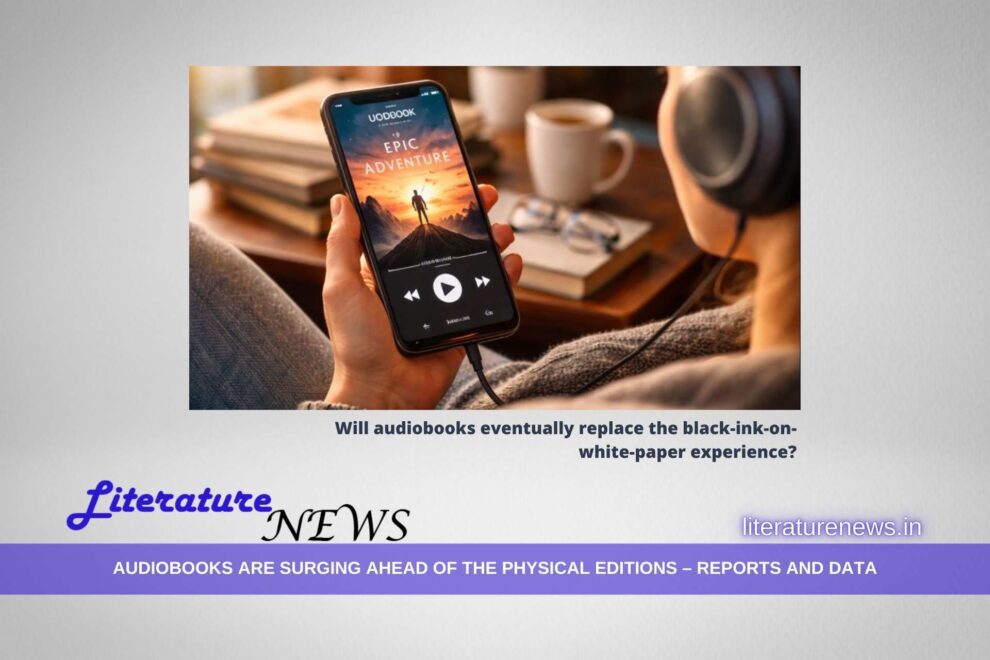
The steady ascent of audiobooks has now reached a decisive moment. Industry data through 2025 confirms what publishers, booksellers, and authors have observed anecdotally for several years: for select major titles, audiobooks are no longer supplementary formats but dominant ones, frequently outselling hardcover editions. This shift, once considered marginal or niche, is now altering the economics, aesthetics and priorities of the global publishing industry.
One of the most cited recent examples is King of Ashes by S. A. Cosby, a title whose audio edition outperformed its hardcover sales across multiple digital platforms. The success of the audiobook version was driven not merely by the author’s reputation but by the synergy of compelling narration, accessibility, and listening habits that increasingly align with contemporary lifestyles. For publishers, such cases are no longer anomalies. They are indicators of a structural transformation underway.
At the heart of this change lies a redefinition of how readers engage with books. Audiobooks have expanded reading beyond the traditionally designated spaces of solitude and stillness. Commuting, exercising, household chores and travel have all become moments of literary consumption. The modern reader, constrained by time yet eager for sustained engagement with long-form narratives, has found in audiobooks a format that accommodates fragmented schedules without sacrificing depth. This practical advantage has translated directly into market growth.
The quality of audiobook production has also evolved significantly. Early audio editions were often treated as afterthoughts, recorded quickly with minimal creative investment. That approach has largely disappeared. Today, leading publishers allocate substantial resources to narration, sound engineering and casting. Skilled narrators, sometimes actors with established reputations, are chosen not only for clarity but for their ability to embody character, tone and emotional cadence. In crime fiction, literary fiction and narrative non-fiction alike, narration has become a form of interpretation that can enhance, rather than merely replicate, the reading experience.
In the case of King of Ashes, listeners and critics alike pointed to narration as a decisive factor in the audiobook’s popularity. The voice performance amplified the novel’s moral tension and atmospheric density, allowing listeners to inhabit the narrative with an immediacy that some found even more immersive than print. Such responses underscore a critical point for publishers: audiobooks are no longer passive translations of text. They are interpretive works in their own right.
From an industry perspective, this shift is forcing a reconsideration of publishing strategies. Traditionally, the hardcover release has been treated as the primary commercial and symbolic format, followed by paperback and digital editions. Audiobooks, if produced at all, arrived later in the cycle. That hierarchy is now under pressure. For some titles, audio-first or audio-simultaneous releases are becoming standard practice. Marketing campaigns increasingly foreground audiobook editions, highlighting narrators alongside authors in promotional materials.
The economic implications are substantial. Audiobooks typically command higher prices than ebooks and deliver strong returns relative to production costs once initial investments are recouped. Subscription-based listening platforms have further expanded reach, introducing books to audiences who may not regularly purchase print editions. While these platforms raise complex questions about author compensation and revenue sharing, there is little doubt that they have accelerated the mainstreaming of audiobooks. This transformation also has consequences for authors. Writing for the ear requires a heightened awareness of rhythm, dialogue and clarity. While the core craft of writing remains unchanged, many authors now consider how their prose will sound when spoken aloud. Some report revising sentences to avoid syntactic density that may impede listening comprehension. Others have embraced the performative dimension of audiobooks, actively selecting narrators or even recording their own works.
Critics are also reassessing long-held assumptions. For decades, audiobooks were sometimes viewed as secondary or even inferior to print, associated with convenience rather than literary seriousness. That distinction is rapidly eroding. Major literary prizes now explicitly include audiobooks within their purview, and critical discourse increasingly acknowledges listening as a legitimate mode of scholarly engagement. The question is no longer whether audiobooks count as reading, but how they reshape interpretive experience.
The rise of audiobooks has also had a democratising effect. For readers with visual impairments, learning differences or physical constraints, audiobooks have long offered accessibility. What has changed is that this accessibility is now embedded within mainstream consumption rather than relegated to specialist provision. As audiobook usage expands across demographics, accessibility is no longer a marginal concern but a central design principle of publishing.
At the same time, the surge in audiobooks has prompted anxieties within parts of the literary ecosystem. Independent bookstores, already navigating the challenges posed by e-commerce and digital reading, have limited capacity to participate directly in audiobook sales. Some publishers and retailers are experimenting with hybrid models, offering audiobook codes alongside print purchases, but such initiatives remain uneven. The risk is that audio’s growth could further decouple literary consumption from physical bookspaces, with long-term implications for community-based literary culture. Publishers are acutely aware of this tension. Many insist that audiobooks do not replace print but coexist with it, serving different reader needs at various moments. Industry data suggests that audiobook listeners are often among the most engaged readers, frequently consuming multiple formats simultaneously. Rather than cannibalising print sales across the board, audiobooks may be expanding overall readership by reaching those who might otherwise disengage from long-form reading altogether.
Looking ahead, analysts predict that the audiobook market will continue to expand, though perhaps at a more stabilised pace. Artificial intelligence and synthetic narration remain contentious topics, with publishers and authors expressing caution about their ethical and artistic implications. For now, the emphasis remains firmly on human narration and high production standards, reflecting an understanding that trust and authenticity are central to the format’s appeal.
What is increasingly clear is that audiobooks are no longer an auxiliary concern. Their success is reshaping how publishers think about format hierarchy, how authors feel about craft, and how readers integrate literature into daily life. The case of King of Ashes is emblematic rather than exceptional. It signals a broader recalibration within publishing, one in which listening is no longer secondary to reading but an equally authoritative way to encounter stories.
As the industry adapts to this reality, the question is not whether audiobooks will endure, but how deeply they will influence the future of literary production and criticism. In a culture defined by mobility, multitasking and digital mediation, the human voice has reasserted its ancient role as a vehicle for narrative. The audiobook boom, far from diluting literature, may be reminding the publishing world of storytelling’s oldest truth: that stories were first heard before they were ever read.
News Desk
Literature News


Add Comment