

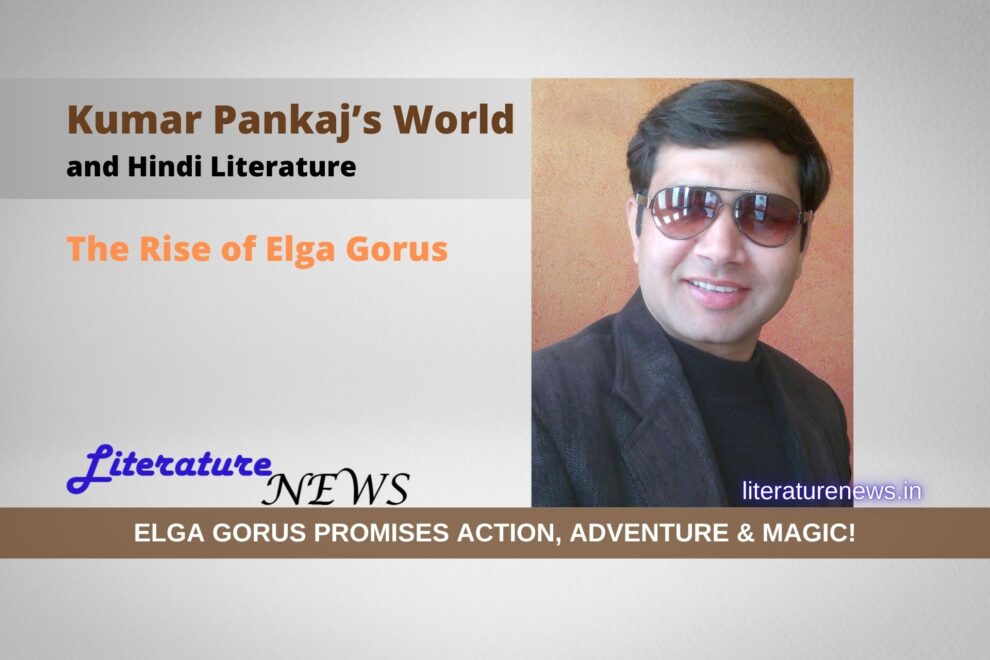
In contemporary Hindi publishing, it is often possible to predict the direction a young writer will take. The market has its own temptations. Romantic fiction attracts immediate attention, social media visibility, and a ready-made readership. Relationship-driven narratives are comparatively easier to market and often guarantee quicker commercial success. Against this backdrop, Kumar Pankaj’s emergence as the creator of Elga Gorus becomes particularly interesting. Instead of choosing the safer and more established path, he chose one of the most difficult routes available to a novelist: constructing an entirely original fantasy universe. Whether one ultimately agrees with every creative decision he makes or not, there is no denying that the choice itself reveals a writer driven more by artistic conviction than by market trends. This willingness to resist prevailing fashions may eventually become one of the defining features of his literary identity.
The first quality that becomes evident while assessing Kumar Pankaj as an author is the scale of his imagination. Imagination is a word frequently used in literary discussions, often so casually that it loses meaning. In Pankaj’s case, however, the term deserves to be taken seriously. Many writers imagine stories. Kumar Pankaj appears to imagine worlds. There is an important distinction between the two. A story may require a plot, a few characters, and a setting. A world requires histories, geographies, mythologies, belief systems, symbolic structures, and an internal logic capable of sustaining hundreds of pages of narrative. What distinguishes Elga Gorus is not merely the presence of unusual creatures or mysterious locations, but the sense that every element belongs to a larger and interconnected imaginative framework. Readers repeatedly encounter suggestions of unseen histories and unexplored territories, creating the impression that the visible narrative is only one part of a much larger universe.
Equally significant is the author’s literary vision. Most novelists begin with a story they wish to tell. Kumar Pankaj appears to begin with a question about what Hindi literature can become. His work suggests a broader ambition than simply entertaining readers. He seems interested in expanding the boundaries of contemporary Hindi fiction itself. For several decades, Hindi literature has excelled in realism, social commentary, historical reflection, and psychological exploration. What has remained comparatively underdeveloped is large-scale fantasy fiction capable of competing for the attention of readers who increasingly consume global speculative literature. Pankaj’s work can therefore be viewed as part of a larger literary intervention. He is not merely contributing another novel to the marketplace. He is attempting to demonstrate that Hindi literature possesses the capacity to sustain complex, immersive, and ambitious fantasy worlds of its own.
His writing style reflects this ambition. One of the most noticeable characteristics of his prose is its visual orientation. Some writers think primarily through dialogue. Others think through ideas. Kumar Pankaj seems to think through images. His descriptions frequently function like carefully composed cinematic sequences. Locations are not simply identified; they are revealed. Creatures are not merely introduced; they are staged. The reader often experiences scenes through a succession of visual impressions that gradually accumulate into an atmosphere. This approach explains why many readers describe his work as highly immersive. The visual quality of the prose allows the fictional world to acquire a degree of tangible reality. While some literary purists may prefer greater psychological introspection or linguistic restraint, there is little doubt that his descriptive abilities constitute one of his strongest artistic assets.
Another aspect worth examining is his relationship with mystery. Many contemporary novels rely heavily upon emotional drama to sustain reader interest. Kumar Pankaj relies instead upon curiosity. This may seem like a simple distinction, but it has important implications for narrative structure. Curiosity-driven fiction requires the author to carefully manage information, withholding certain details while gradually revealing others. It demands long-term planning and structural discipline. Throughout Elga Gorus, one notices a writer who understands the value of unanswered questions. Mysteries are not merely inserted for temporary excitement. They form part of the architecture of the narrative. Readers continue because they wish to understand the world more fully. This technique creates a different kind of engagement from that produced by conventional romantic or relationship-centred fiction. Instead of emotional anticipation alone, the reader experiences intellectual anticipation as well.
Perhaps the most admirable aspect of Kumar Pankaj’s career thus far is his willingness to pursue readers who are often overlooked by mainstream Hindi publishing. For years, young readers interested in fantasy, mythology, speculative fiction, and large-scale adventure narratives have largely migrated toward English-language literature. This migration was not necessarily driven by linguistic preference but by availability. The books they wanted simply existed in greater numbers elsewhere. Kumar Pankaj appears to have recognised this gap and decided to address it directly. His novels suggest an understanding that Hindi literature cannot rely indefinitely upon inherited readerships. It must cultivate new ones. In choosing fantasy rather than romance as his primary vehicle, he effectively positioned himself within a category that remains comparatively underdeveloped but potentially rich with possibilities.
That choice becomes even more significant when viewed against contemporary publishing trends. Romantic fiction enjoys immediate recognisability. Readers understand its conventions. Publishers understand its market. Social media algorithms often reward its themes. Fantasy, particularly original fantasy rooted in an unfamiliar mythology, presents far greater risks. It demands more from both writer and reader. Kumar Pankaj’s decision to invest years of creative labour into such a project therefore reveals a considerable degree of confidence. It suggests a writer who believes readers are capable of embracing complexity and imaginative challenge. Whether one interprets this confidence as idealism or strategic foresight, it remains an unusual quality in a literary environment increasingly shaped by market calculations.
No serious assessment, however, should become entirely celebratory. Kumar Pankaj’s strengths occasionally create corresponding weaknesses. His enthusiasm for world-building can sometimes generate narrative density. The abundance of characters, concepts, histories, and mythological details may overwhelm readers accustomed to more streamlined storytelling. At times, one senses that the author’s imagination is moving faster than the reader’s ability to process information. Yet these limitations arise largely from excess rather than insufficiency. They are the by-products of ambition. Indeed, many influential fantasy writers encountered similar criticisms early in their careers. The challenge for Kumar Pankaj moving forward will be refining his structural economy without sacrificing the expansiveness that distinguishes his work.
What makes him particularly interesting from a literary perspective is that he seems less interested in genre than in possibility. While Elga Gorus is often described as fantasy, the novels incorporate elements of mystery, mythology, adventure, allegory, and philosophical speculation. This hybrid quality may ultimately prove beneficial. Pure genre writing sometimes becomes constrained by convention. Kumar Pankaj appears more willing to borrow freely from multiple traditions. Such flexibility could allow his future work to evolve in unexpected directions. One can easily imagine him expanding beyond fantasy into broader forms of speculative or mythological fiction while retaining the imaginative energy that defines his current work.
The most important question regarding Kumar Pankaj’s future is not whether he can write another successful novel. It is whether he can continue building the readership he has begun to attract. Literary influence is not determined solely by individual books. It emerges when an author changes reader expectations. There are signs that Kumar Pankaj may be doing precisely that. Younger readers who previously looked elsewhere for large-scale imaginative storytelling are beginning to encounter such experiences within Hindi literature itself. If this trend continues, his significance may extend beyond his own novels. He may come to be viewed as part of a broader movement that expanded the imaginative possibilities available to Hindi readers.
Ultimately, Kumar Pankaj stands out because he combines three qualities that do not always coexist. He possesses vision, ambition, and execution. Vision without execution produces unrealised dreams. Execution without vision produces competent but forgettable work. Ambition without discipline often results in chaos. What makes Kumar Pankaj worth watching is that all three qualities are present, even if they are still evolving. He is a writer willing to take risks, challenge assumptions about what Hindi readers want, and invest himself in projects whose rewards are far from guaranteed. Whether one views Elga Gorus as a major achievement or as the beginning of a larger journey, it clearly establishes him as a distinctive voice in contemporary Hindi literature. More importantly, it establishes him as a writer who believes that imagination deserves a central place in literature’s future.
Parmarth for Literature News
Thanks for reading this article!
..


Add Comment